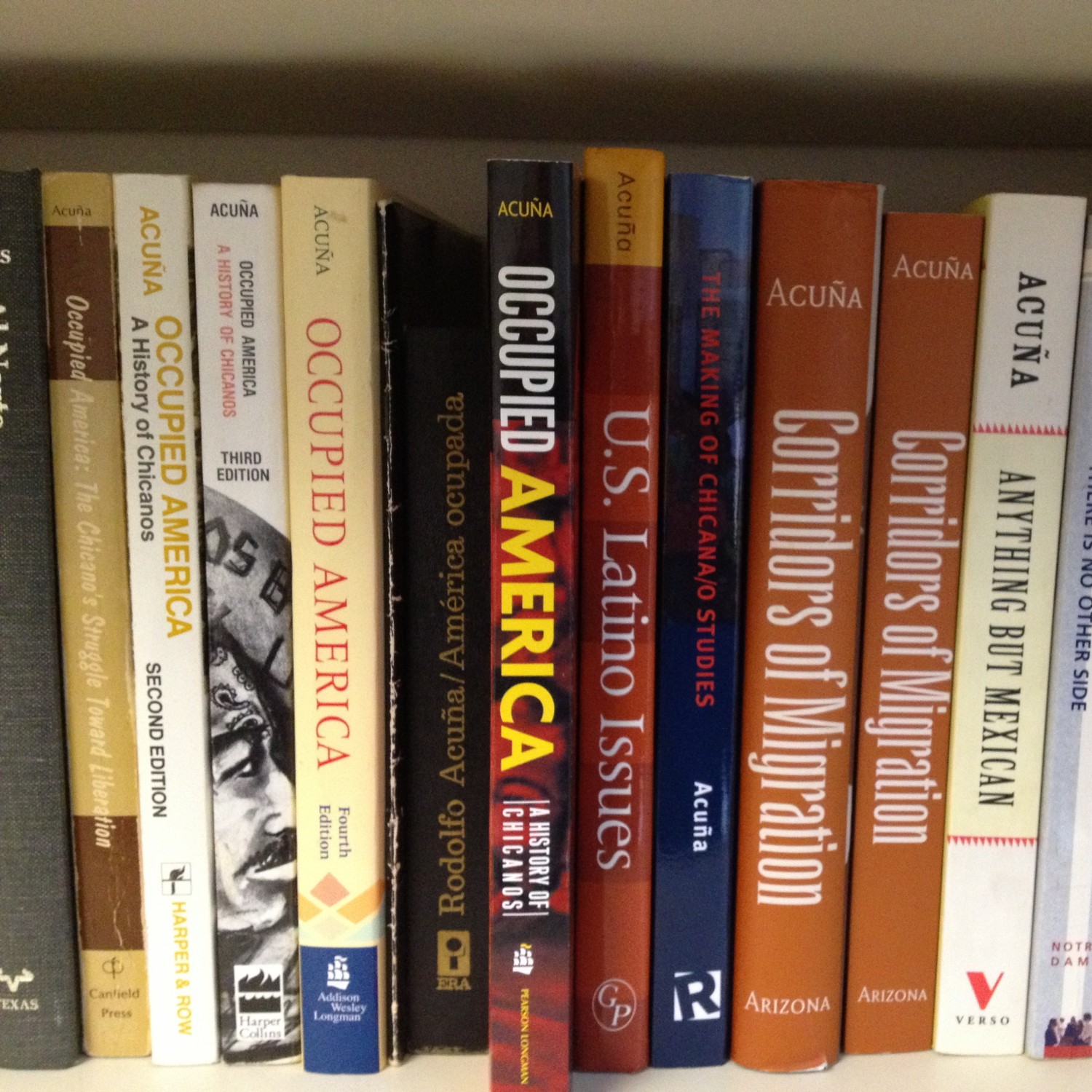
(RE)reading Occupied America…

Untitled

“The role of Chicana/o Studies is to organize and systemize the knowledge of people of Mexican descent, as well as to serve as a pedagogical tool to educate and motivate.”

Rodolfo F. Acuña, The Making of Chicana/ Studies, xxi

As we end the year, I reflect on the opportunities I have received this year. One of them was to present on the importance of Acuña’s Occupied America in Chicana/o Studies and History at the annual NACCS Conference in Chicago. This panel would not have happen without my conference booking agent, my brother Jose G. Moreno. Thanks for the opportunity!

My short presentation was titled, Searching For Chicana/o History: A Reflection On Dr. Rodolfo F. Acuña’s Occupied America And Archives. Here is the rough draft of the presentation. I hope you enjoy it!

Today discussion plays an important part in our struggle for liberation. And yes, I said liberation! As we sit here reflecting on the impact of Occupied America inside and outside of the ivory tower. There is a war-taking place throughout the United States and we (Chicana/os and Latina/os) are still the target.

The attacks toward us in Arizona, Alabama, and elsewhere are not new. Since the construction of US/Mexico Border in 1848, we as a community have faced decades of discrimination and attacks! Those attacks have made us stronger and has created a collective memory of struggles. So in this context, Dr. Acuña’s Occupied America was written.

For me, I share the 40 years history with Occupied America due to being born in 1972. But it was not until 1993, that I was introduced to his writings in my first of many Chicano Studies classes. And believe me, I taken many classes, which I have earned three degrees in Chicano Studies.

Throughout the last 40 years, Occupied America has gone through much revision by expanding the story. For some of us, we return to Occupied America, First Edition were he argues, “that Chicanos…are a colonized people.” And he is “convinced that the experience of Chicanos…parallels that of other Third World people who has suffered under colonialism.” Just like that, in the first few pages of Occupied America, First Edition, he introduces us to colonialism and connect us to the larger struggle against imperialism in the world.

But by the Second Edition, he returned “to the basics and collect[ed] [the] historical data.” Making “this version of Occupied America reflect[ing] [his] current understanding of the history of Chicanos.” He pointed out that, “all research must be put into the context of the historical process.”

In the following editions after one and two, he continued to re-examine the historical process by expanding the narrative of the story. By doing that, making each editions different from each other or he would say “less imperfect that previous one.”

It is important to mention and give credit to Dr. Acuña and Occupied America, First Edition, which challenged the “Frontier Thesis” of borderland scholars and history by addressing race, class, and later gender in the development of the West (or the Southwest). He addressed the “legacy of conquest” years before the movement of “New Western History” in the late 1980’s. And I believe without Occupied America, First Edition, you would not have the works of Limerick, Weber, and other borderland scholars. But that is a story for a different discussion or panel.

Moving forward, my presentation will focus on my experience on organizing Rodolfo F. Acuña Collection at CSUN by reflecting on my search for Chicana/o history through his archives and Occupied America. The overall goal is to highlight the importance of archives in the writing of Occupied America.

I began this story in 2004, when I was a graduate student in Chicano Studies at CSUN. As, I was waiting for a class; I came across a flyer announcing that the Urban Archives Center was looking for interns to help in the processing of Dr. Acuña Collection. So like any other graduate student, I decided to add more work to my life and took on an internship at the center. And I guess the reason I took on the task is to gain a better understanding of the historian craft and Chicana/o history. But the real reason, I wanted to see or find the sources of his writings, especially Occupied America.

And for the record, the task of processing his collection would not be easy due to being composed of more than two hundred boxes! For being a historian, he decided to save mostly everything he collected in his career as activist-scholar. For me, I took on task of processing his collection by taking on the role of a detective. In this role, I began to search every boxes looking from the evidence or connection to Chicana/o history!

As time want on, I came across numerous archives, like the Paul Taylor Collection and the Federal Writers’ Project, which focused on farm labor and strike of the 1930s. Also, he saved numerous journals, newsletters, and newspaper, like La Gente de Azltan, El Popo, and La Raza Magazine. But the most important find for me was an original draft of Occupied America. I was amazed that I found the draft but I was shocked that it was typed on yellow notebook paper! Yes, yellow notebook paper!

During the three years of processing his collection, I moved from an intern, to a graduate archivist, and at the end was an assistant archivist. In this time, I also came to realize that every historian is archivist and every archivist is a historian. The overall experience of searching for Chicana/o history among his archives gave me a stronger link to our collective history. In this sense, I came to understanding through his archives and Occupied America the importance of the historical document in the narrative of Chicana/o history.

So, I end this presentation with the following statement, they can ban our books but they cannot destroy our collective memory or knowledge of our community. The time is now to FIGHT BACK!

c/s

Violence on the Oxnard Plain: The Oxnard Police Department and the Mexican Community

Untitled

Local Mural in La Colonia (2012). Courtesy of the author’s photo collection.

“Who writes for his people ought to use the past with the intention of opening the future, as an invitation to action and a basis for hope.”

Frantz Fanon, The Wretched of the Earth, 232

It is essential to mention, as I focus my research and writing on the history of Mexicans in La Colonia, it’s not a random topic to me. My mother’s family migrated into the Oxnard Plain during the 1930s as agricultural workers. They first settled in the free abode housing off 5th Street, then moved into the Meta Street neighborhood near Oxnard Blvd. And finally they brought a lot in La Colonia in the 1940s.

I have deep roots in Oxnard and La Colonia. Also, my research and writing are connected to my twenty years as a community organizer! I have first-hand knowledge of police brutality in my neighborhood.

Local Newspaper

Local newspaper microfilms at the local library (2009). Courtesy of the author’s photo collection.

I have spent many years collecting materials on the history of Mexicans on the Oxnard Plain. In that time, I spend hours in the microfilm room in the local library examining the local newspaper, the Oxnard Press-Courier (OPC) My goal was to develop a historical timeline by utilizing the local newspaper as a primary source in the development of the Mexican community in Oxnard, especially La Colonia neighborhood.

As I connected the dots in linking the Mexican community to numerous struggles in labor, politics, and education, it became clear to me that the local newspaper also played another part in the historical narrative. The OPC was utilized to construct stereotypes of the Mexican community! Over and over in the pages of the local newspaper, city officials, growers, police chiefs & officers, and other community members labeled Mexicans as criminals, uneducated, or as disposable labor!

Untitled

Source: “300 Mexicans Swarm After Ramirez Arrest” The Oxnard Daily Courier, 26 Dec 1934

And those stereotypes continue into today. As the local newspaper spread those stereotypes, the Oxnard Police Department (OPD) played an important part as the enforcer by using violence toward the Mexican community.

It is evident that the OPD is not our friend! This can be seen in the police killing of Robert Ramirez and Alfonso Limon within the last eight months of 2012. So, it is vital to support the organizing of the Todo Poder Al Pueblo, Union del Barrio, and other organizations in their mission to expose the crimes of the OPD!

Please read the following article on the current violence against the Mexican community; “No Justice, No Peace”: The People of Oxnard Continue to Gather Strength in the Fight Against Police Brutality. Also, check out the following videos.

The violence toward the Mexican community is not new to Oxnard; it has a historical past.

The following is an excerpt from my manuscript (rough draft), Searching for Memories in La Colonia: Migration, Labor, and Activism In Oxnard, California, 1930-1980, highlighting some of the tension and violence toward the Mexican community during the 1940s & 1950s by the Oxnard Police Department.

Untitled

Source: “Police use tear gas against local crowd,” Oxnard Press-Courier, 2 Feb 1942

In the Mexican neighborhoods of Oxnard during the 1940s, tension and conflict continued between the police, growers, and Mexicans. This tension could be seen in the way the Oxnard Police Department (OPD) interacted with the overall Mexican working-class community. The OPD was utilized as the enforcer of Oxnard’s power structure to keep Mexicans in their place or neighborhoods. A clear example of enforcement occurred on January 31, 1942 in the Meta Street neighborhood, as the police threw tear gas into a crowd of working-class Mexicans, who were watching people dancing in the street. The police labeled it a riot and arrested a number of Mexicans for disturbing the peace.

Untitled

Source: “Police quell Colonia riot,” Oxnard Press-Courier, 23 Apr 1955

Conflicts between the police and Mexicans continued into the 1950s with a number of so-called riots. In 1955, the police responded to a fight off Cooper Road in La Colonia, which sparked a clash between the police and residents. The tension led to a number of residents throwing bottles and spitting & cursing at the police. The police responded by throwing a teargas bomb into the crowd of two hundred residents. In the end, one police car was damaged.

Untitled

Source: “5 men, 5 teenagers arrested in rioting, several injured,” Oxnard Press-Courier, 27 Aug 1956

The following years, another police riot rocked La Colonia. On August 26, 1956, more than one thousand residents were attending a church bazaar sponsored by the Christ the King Church on Cooper Road. The riot was touched off by the arrest of Richard Madrid, a few blocks away from the bazaar. Again, like the previous riot, tension between the police and residents led to the police being bombarded with rocks, beer cans, and bottles from the crowd. The police responded by launching more than 50 tear gas bombs into the crowd. In its aftermath, several officers and residents were injured and ten individuals were arrested, with five being juveniles. They were charged with disturbing the peace and failure to disperse. Police Chief Carl Hartmeyer stated, “we had to break the riot up and since the mob wouldn’t disperse, we had to use drastic measures. I’ll say this: tear gas is a lot better than shotguns.”

Sources: “Police use tear gas against local crowd,” Oxnard Press-Courier, 2 Feb 1942; “Police quell Colonia riot,” Oxnard Press-Courier, 23 Apr 1955; “5 men, 5 teenagers arrested in rioting, several injured,” Oxnard Press-Courier, 27 Aug 1956; Juan Soria, Interview by Frank Bradacke, Oxnard, Ca, 25 Jan 1996.

c/s